Sharing is caring!
As cat owners, we always want to make sure we keep our cat’s healthy, happy, and most importantly – safe.
Whether you have an inside cat or outside cat, your cat needs to wear a collar with an identity tag.
An identity tag is a lost cat’s first line of defense – it’s the only way for anyone who comes in contact with your lost cat to immediately know how to reach you and reunite you with your kitty.
Hear me out before you make any quick decisions– there’s a right and wrong way to do this.
We’ll walk through when your cat needs to be wearing a collar/ID tag along with what kind of collar is best and what their ID tag needs to say.
Keep reading to find out how to optimize your cat’s collar and ID tag in a way that will maximizes the chances of them being returned if lost.
Table of Contents
Why do indoor cats need a collar and ID tag?
No one wants to imagine losing their cat – it’s a cat owner’s worst nightmare!
But the reality is that accidents happen and you must be prepared for them.
It’s not uncommon for indoor cats dart out the door and for outdoor cats to stray too far from home.
A classic collar and ID tag with your contact information is still the most effective way for lost cats to be reunited with their owners.
In fact, International Cat Care states that putting an ID on your kitty is an essential part of cat welfare.
Click here to skip ahead and read my own personal experience with being reunited with my lost indoor cats thanks to their collars and ID tags.
Why do outdoor cats need an ID tag?
Ideally, all cats would be kept indoors and only have outdoor access with a catio/enclosure or under supervision with a harness and leash.
But we’re not here to shame you for letting your cats outdoors.
Here at National Kitty, we want to help guide all types of cat owners with educational content intended to help their cats life happy, healthy lives.
That being said, it’s important to offer safety protocols to both indoor and outdoor cat owners.
Outdoor cats need collars with an ID tags mainly because other people need to know that cat belongs to someone.
Unidentifiable cats are often mistook as strays and taken by others or whisked away to animal control facilities where they face euthanasia.
Don’t rely on a microchip alone; you can’t rely on whoever finds your cat to get them scanned for a chip.
American Humane recommends stresses the importance of getting cats microchipped and wearing a collar with ID tag.
Here are a few other reasons outdoor cats need collars with ID tags:
But what if my cat hates collars?
It’s very likely your cat will hate the collar, especially if they didn’t have one as kittens.
It’s not necessarily the collar your cat hates – it’s the sudden change.
Cats are habitual creatures that like routine.
Ideally, you should put your cat in a collar while they are still kittens.
However, it’s not too late to get an adult cat to wear a collar too.
Through “collar training“, you can ease your cat into a collar to make the transition easier.
Getting your cat used to wearing a collar
Start by putting the collar on your cat for 10 minutes a day and reward him/her with a treat as soon as the collar comes on.
The treat will hopefully distract them from the stress of the collar and they’ll start to associate the collar with a reward.
Each day, add an extra 10 minutes to the length of time your kitty wears the collar, all while rewarding them with treats, until you reach an hour.
Now your kitty should be ready to wear its collar full-time.
**AUTHOR’S NOTE** Some adult cats, like my own, do not mind the collar. I simply put on the collar and he accepted it. Collar training isn’t always necessary.
Does my indoor cat need to wear a collar ALL the time?
This is really based on your living situation.
For example, I live alone with my two cats. I don’t have to worry about kids or irresponsible roommates letting my cats out on accident.
But there are still plenty of conditions that make them need collars.
Here’s my personal list of conditions where collars are mandatory:
**AUTHOR’S NOTE** My cats tend to look forward to the collar because they know it means they’re about to enjoy some fresh air outside (under supervision).
Get the right collar – Prevent choking hazards
Most cat owners don’t make their cats wear collars because of choking hazards.
This is legitimate concern, but there is a readily available solution.
ONLY buy collars with safety release clasp and test the release function before putting it on your cat.
Safety release clips are designed to prevent your cat from choking if your cat’s collar gets stuck on something.
If the collar is pulled with enough resistance in the opposite direction, the safety release clasp pops open and your cat can freely move around.
Not all safety release clips are made equally.
Always test out the safety release clip by seeing how much force it takes for you to trigger the release.
If too much force is required, then it is not safe for your cat.
Only moderate force should be required to trigger the safety release function.
DO NOT buy collars that fasten like an adjustable belt or buckle like a seat belt.
These collars may seem like attractive options because of their designs, but these types of collars pose a serious choking hazard risk.
What is the best type of collar for my cat?
I’m sure you want your cat’s collar to be pretty and make your kitty look cute.
But remember that collars serve a very important purpose – to keep your cat safe.
The good news is that you can have the best of both worlds: a collar that’s cute and safe!
National Kitty teamed up with cat rescuers to design a functional, veterinarian approved, aesthetically pleasing collar with these safety features:
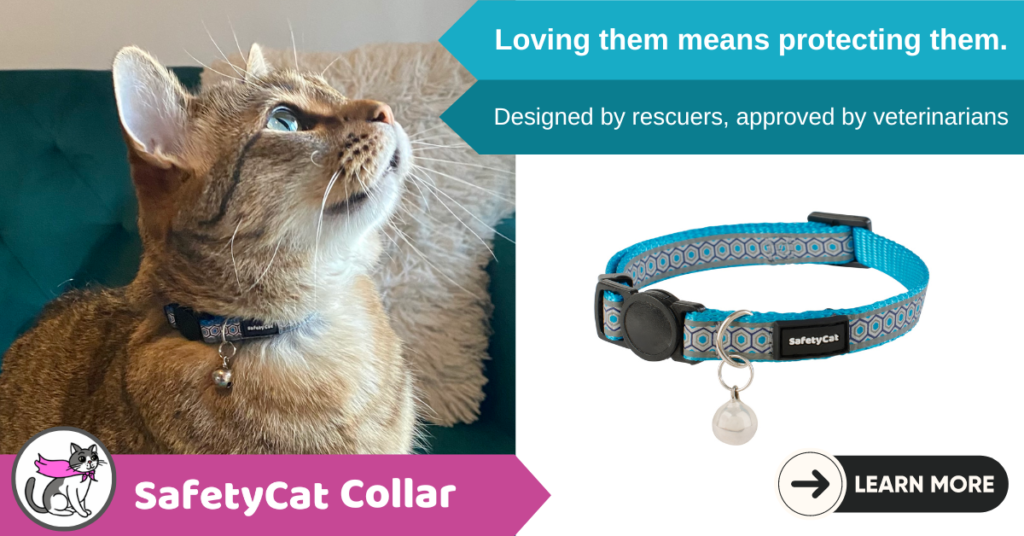
Publishing inspiring rescue stories led us to become intimately familiar with what’s needed to keep our kitties safe and sound.
We designed the SafetyCat collar with your cat’s comfort and safety in mind.
The breakaway clasp prevents choking hazards by coming apart when met with tension in opposite directions.
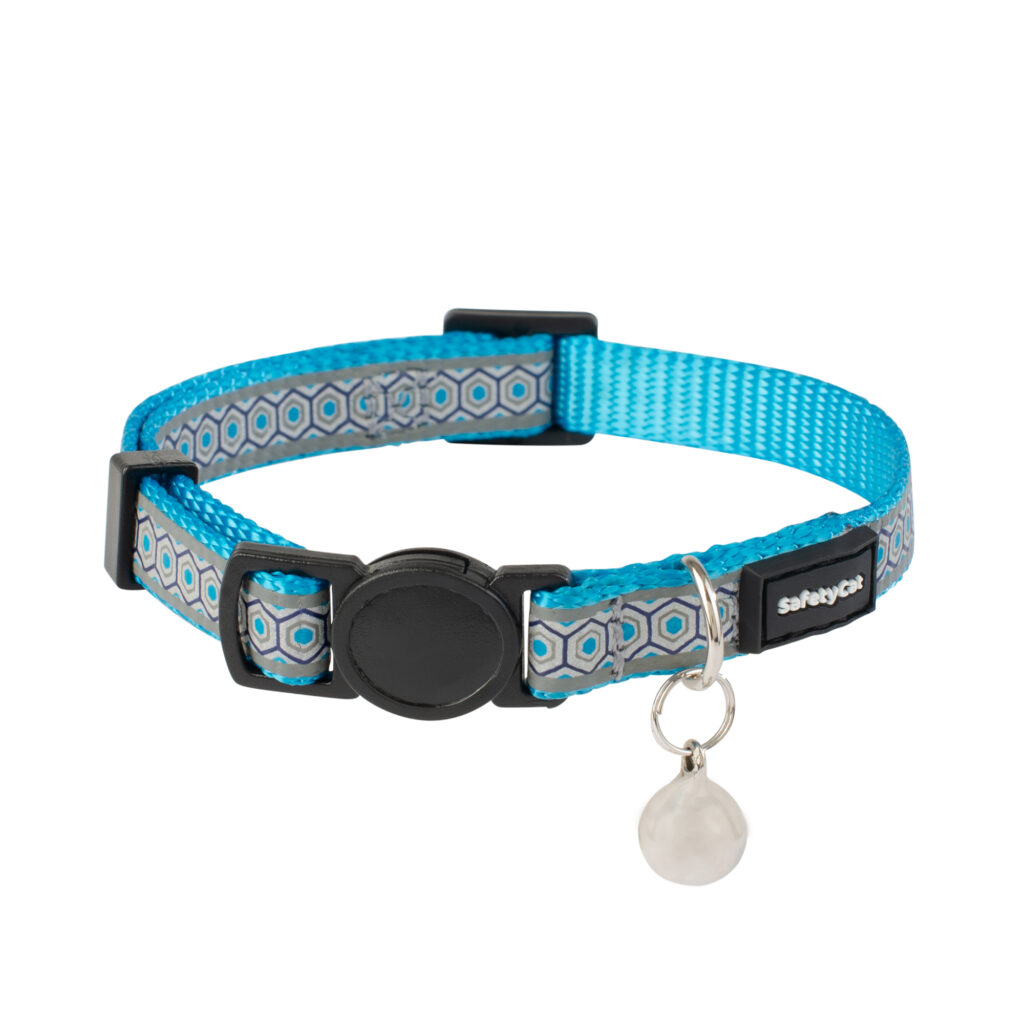
The bell helps you identify whether your cat is nearby with a familiar jingle; it can also be removed for those who prefer something more quiet.
The reflective design allows cars driving at night to see the cat from a distance, therefore preventing collision.
We created the SafetyCat collar to give cat parents some peace of mind.
Our feline family certainly enjoys it, and we hope yours will too!
What should my cat’s ID tag say?
The obvious answer is that your cat’s ID tag should include your contact information, but there’s something VERY important people fail to include.
Your cat’s ID tag must specify whether your cat is indoor or indoor/outdoor.
Whoever reads the ID tag needs to know whether your cat is indoor/lost or if it’s normal for them to be outside.
Here are some examples of how to communicate your cat’s living conditions on an ID tag.
ID tags allow a limited number of words and characters, especially one that’s small and intended to be comfortable for cats.
Prioritize what’s printed on the ID tag based on how much space is available.
It’s best to get an ID tag that can be printed on both the front and back.
I personally order my ID tags from GoTags.
Here’s more information you should consider when determining what your cat’s ID tag should say.
It should go without saying that if your phone number or address changes, you’ll need an ID tag with updated information.
How a collar & ID tag saved my cats
Once upon a time, I returned home from a long day of work to find that my cats were missing.
The maintenance man who’d been working on my dishwasher had left the door open while he was carrying in supplies, unknowingly letting my two cats slip outside.
It’s every cat owner’s worst nightmare. The next 3 hours were filled with utter horror and panic as I searched my neighborhood for my missing cats.
Just when I was about to give up searching for the evening, I looked down at my phone and had a voicemail from an unknown number.
It was a woman saying my cats were on her porch.
The woman had left out food for her feral cat colony when she noticed two cats with shiny collars.
“The reflection from their collars caught my eye, which made me realize they weren’t stray cats,” said the woman.
Had it not been for their collars, she would have never noticed them or approached them to read their ID tags and contact me.
The collars signaled that they weren’t strays and belonged to someone.
At that moment I was so grateful I’d planned for an emergency scenario like this.
I hope my story inspires you to always remember that it’s better to be safe than sorry.
Does your kitty have an ID tag? If so, what information did you include? Tell us in the comments below!
Get the best cat stories right in your mailbox!
Sharing is caring!
Comentarios
Publicar un comentario